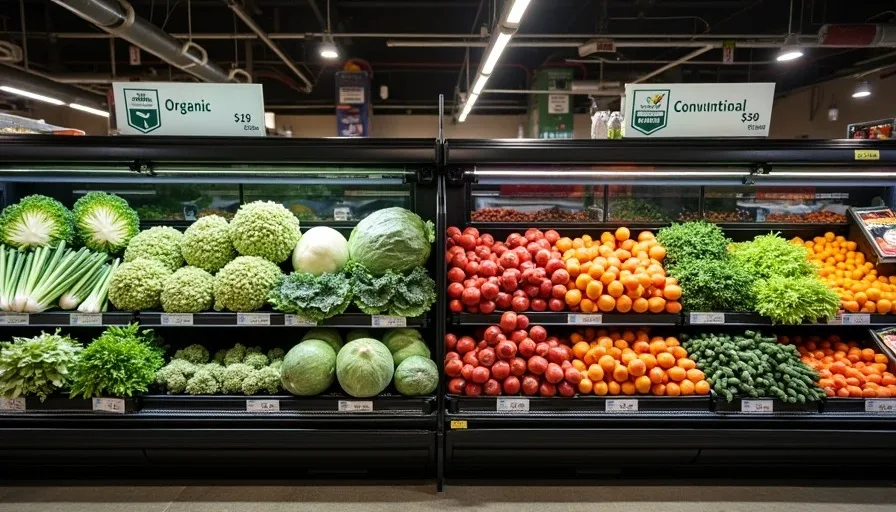
If you’re trying to eat on $40–60 a week, the “just buy organic” advice is some of the least helpful noise you can listen to. The price gap is real, the nutritional difference is usually tiny or nonexistent, and the money you spend on the organic sticker is money you can’t spend on actual calories and protein.
This isn’t an argument that organic is fake or that farming practices don’t matter. It’s an argument about priorities when the budget is tight. Most of the time, conventional food that you can afford to buy and cook beats organic food you can only buy in tiny amounts or that forces you to skip meals later in the week.
What You’re Actually Paying For
Organic certification mainly restricts certain pesticides, synthetic fertilizers, and (for meat) antibiotics and specific feed rules. It does not mean the food is more nutritious. Multiple large reviews over the years have found little to no consistent difference in vitamin or mineral content between organic and conventional crops.

For pesticide residue, the differences that exist are usually small. The levels on conventional produce in the U.S. are regulated and, for the vast majority of items, far below amounts that show harm in real-world diets. Washing produce under running water removes a large portion of surface residues on both organic and conventional items. Peeling does even more.
Meanwhile, the price premium is often 20–100% or more. That extra money buys you less food. On a tight budget, less food is the bigger problem.
Where the “Organic Is Better” Argument Falls Apart for Budget Cookers
Produce
Cabbage, bananas, onions, potatoes, carrots, and frozen vegetables are already low-residue items in most testing. Paying double for organic versions of these is mostly branding. The same head of conventional cabbage at $0.39–0.79/lb will feed you for days. The organic one at twice the price feeds you half as long.
Meat and eggs
Organic chicken and ground beef cost significantly more per pound. The practical differences for a home cook are smaller than the marketing suggests. If the choice is organic chicken once a week or conventional chicken three times a week, the conventional option usually wins on both protein intake and total satisfaction. Same logic for eggs.
Pantry staples
Organic rice, beans, oats, and flour rarely taste different enough to justify the markup when you’re cooking simple meals. Store-brand conventional versions perform the same in the pot.
The health impact of eating enough food, including enough protein and vegetables, is larger and better proven than the impact of choosing organic over conventional for most people.

The Few Cases Where Organic Might Make Sense Even on a Budget
I’m not saying never. There are narrow situations where the extra cost can be rational:
You find organic at nearly the same price (it happens on some sale items or store brands).
Specific items you eat in very large amounts raw and unpeeled, and you’d rather minimize residue for personal reasons.
You have a strong personal or ethical reason that outweighs the budget math and you’re willing to eat less overall.
For everyone else living on a real grocery limit, those cases are uncommon.
What Actually Moves the Needle Instead
Spend the difference on:
More total vegetables (conventional)
More eggs or chicken when it’s cheap
Dried beans and lentils
Better storage so you waste less
Wash your produce. Cook it. Eat it. Those steps matter more than the sticker.
I’ve tracked my own grocery bills for years. The weeks I chased organic labels were the weeks I ran out of food sooner or had to cut protein. The weeks I bought conventional sales and focused on volume and variety were the weeks I ate better overall.
If you’ve got data or a personal experience that shows a clear benefit that outweighs the cost on a tight budget, I’m open to hearing it. “It just feels better” is fine as a preference. It just doesn’t change the math for someone trying to stretch $50 across seven days.
Where do you still buy organic even when money is tight, and why? Or have you dropped it completely?